
What a strategy actually controls
Separate the decisions you make from the outcome you would like. You choose whether to play, the stake, which paid options to use and when to stop. Those decisions affect the money you expose. They do not establish that the next floor will succeed, and a chosen multiplier is a target rather than an entitlement.
A practical plan therefore has three numbers: the total amount you can afford to lose, the maximum time you will spend and the most you will commit to any one decision. Optional charges belong inside the same budget. Money already won is still money you can lose; calling it “house money” does not change its value.
The 97% RTP is not a countdown towards a personal refund. A short session can finish far above or below it. Increasing the number of rounds to “let the RTP work” also increases turnover and exposure. Read the RTP explanation before interpreting a session record as evidence of a profitable method.
Three cashout approaches, without invented success rates
Earlier full cashout
An earlier exit settles an available amount sooner and removes it from further exposure in that round. It also gives up the possibility of continuing that particular climb. There is no documented universally safe early multiplier. Even a modest target may never be reached, so descriptions such as “steady income” or “almost guaranteed small wins” are misleading.
Mixed full and partial cashout
From 3×, 50% Cashout allows one half of the current win to be secured while the other half remains active. This is a defined game mechanic, not a promise that half the session bankroll is protected. Decide beforehand whether you understand the split; the amount left in play can still be lost. It should not be confused with Frozen Floor from the original game.
Continuing towards a larger multiplier
Keeping the current amount active leaves it exposed to the next outcome. A larger potential return does not make a loss due to reverse. Rather than assigning an unsupported expected hit rate to targets such as 5× or 20×, this guide focuses on the consequence you can observe: until cashout, the relevant amount has not been secured.
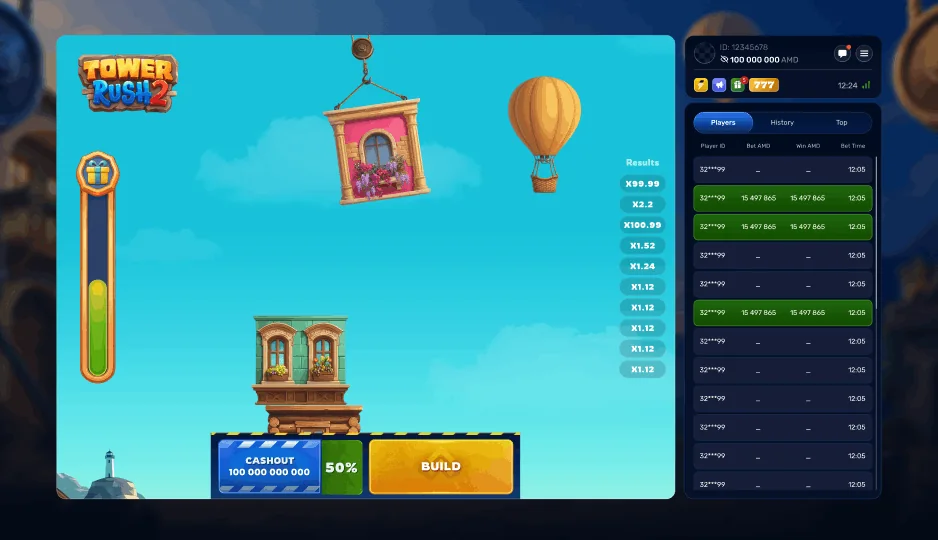
Worked example: does partial cashout cover the cost?
Suppose the base wager is 10 units and the displayed gross win is 30. A 50% Cashout banks 15 and leaves 15 active. If the remaining amount is later lost, the secured 15 stays banked. With only the 10-unit base cost in this simplified example, the settled net result is plus 5 units.
Now include an extra 2.50 units for Double Chance. The same 15-unit banked amount would be 2.50 above total spending of 12.50. This is why “I banked more than my bet” is incomplete when the screen’s base bet does not include every charge. Use the actual settled figures in the client; do not subtract a feature fee twice if the transaction history already includes it.
A partial cashout result also differs from a full 30-unit cashout. The latter settles all 30 at that decision point. Partial cashout instead keeps a possibility of a later return together with the risk on the remaining portion. Neither choice can be judged solely by what the next floor happened to do.
See what the features cost
Use any one currency consistently. These figures explain the rules; they do not predict a round.
Eight betting systems: what changes and what does not
Flat betting
Keep the base wager unchanged across rounds. This makes the cost of ordinary bets easier to track and avoids an automatic increase after losses. It does not cap total session losses by itself: twenty 5-unit losses still consume 100 units. Optional charges must be counted separately.
Martingale
Double the stake after each loss and reset after a win. The sequence 1, 2, 4, 8, 16, 32 costs 63 units if all six bets lose; the next stake would be 64. Recovery claims also assume a suitable payout. A 1.5× gross return is not the same as an even-money 2× return, so a familiar doubling rule cannot simply be imported without checking the arithmetic.
Reverse Martingale
Increase stakes after wins rather than losses. This exposes more money after a successful sequence and can surrender earlier gains in the next round. A string of wins is not evidence that the next outcome has become more favourable.
D’Alembert
Raise the stake by one unit after a loss and lower it after a win, subject to a minimum. The growth is slower than doubling, but it is still an escalation. Five losing stakes of 1, 2, 3, 4 and 5 cost 15 units rather than the 5 units of flat staking.
Fibonacci
Follow a sequence such as 1, 1, 2, 3, 5, 8 and 13. The first seven losing stakes total 33 units. Moving backwards after wins does not establish recovery when payouts vary, and the sequence cannot continue indefinitely with a finite balance.
Zig-zag cashout targets
Alternate two predetermined exit targets. This changes the decision pattern, not the available information about future floors. A poor result at the lower target does not make the next higher-target round more likely to succeed.
Split-stake or “dual-bet hedge”
Dividing a budget across separate rounds reduces the amount placed on each individual decision, but the rounds do not become a genuine hedge merely because the targets differ. Both can lose. The provider information used here does not establish a simultaneous dual-bet control for Tower Rush 2, so this is a budget example rather than an instruction to use an unverified feature.
Kelly criterion
Kelly sizing requires a defensible estimate of an advantage and the relevant payoff probabilities. A remembered streak is not such an estimate. With no established positive edge, a Kelly formula is not a mathematical justification for gambling a percentage of your bankroll.
| Illustrative loss sequence | Stakes in units | Total after six losses |
|---|---|---|
| Flat | 1, 1, 1, 1, 1, 1 | 6 |
| Martingale | 1, 2, 4, 8, 16, 32 | 63 |
| D’Alembert escalation | 1, 2, 3, 4, 5, 6 | 21 |
| Fibonacci escalation | 1, 1, 2, 3, 5, 8 | 20 |

How the sequel’s paid options affect a session
Buy Bonus costs 100 times the selected base bet. At 2 units, that is 200 units committed in one purchase. Double Chance adds 25% to the stake, so ten base wagers of 8 units cost 100 units with the option active instead of 80 without it. These are cost calculations, not estimates of the winnings either route will produce.
Re-Buy creates a separate decision after a qualifying loss. If the relevant preceding win was 200 units, the stated 70% price is 140 units. The fact that a player had briefly seen 200 on screen does not make 140 a discount on money that was already withdrawn. It is a new charge for a continuation and is available only under the game’s conditions.
The Progress Bar deserves its own stopping rule. A partly filled meter can create pressure to continue because stopping feels like abandoning progress. Your spending limit should still apply. The provider’s description establishes the trigger at 100%; it does not turn unfinished progress into cash owed to you.

Five mistakes to remove from the plan
Changing an exit decision solely because the tower looks impressive makes the original plan meaningless. Review the decision between rounds rather than interpreting animation as new predictive information.
Treating a demo run as a statistical test is another mistake. A few dozen or even a few hundred outcomes cannot substantiate the precision claimed by a “winning system”. Use the demo to locate controls, practise reading amounts and understand features.
Escalating stakes to repair a previous loss increases exposure at exactly the moment the decision may be emotionally driven. A predetermined cap is useful only if it includes the next proposed stake and all feature charges.
Copying original-game bonus advice into the sequel can produce the wrong decision. Frozen Floor, Temple Floor, the ten-floor Bonus Round and 50% Cashout are not interchangeable labels. Read the rules for the title actually open on your screen.
Finally, leaving the stopping condition undefined invites repeated extensions: one more bonus trigger, one more Re-Buy, one more attempt to break even. End the session at the planned time or spending limit. If stopping feels difficult, use the account-control and support options.
Frequently asked questions
What is the best Tower Rush 2 cashout target?
No universally best or guaranteed target is established by the provider information. A target changes your decision rule; it does not promise the tower will reach it.
Does Martingale work with a low cashout multiplier?
Doubling does not guarantee recovery. The payout multiple matters: a 1.5× gross return differs from the 2× return assumed by familiar even-money examples, and losses can exhaust a balance.
Does 50% Cashout guarantee profit?
It secures half of an eligible current win, not half your session spending. Net profit depends on all stakes and feature costs.
Should I Re-Buy after every qualifying loss?
A qualifying prompt is an option, not an obligation. The price is a new cost, and the continuation can lose. Decide whether to use it before the session.
Can the progress meter predict the next floor?
No such predictive function is established. The documented role is to trigger the Bonus Round at 100%.
Does this guide recommend a betting system?
It explains how the systems change spending and why none establishes guaranteed profit. Affordable limits and the option not to play take priority.